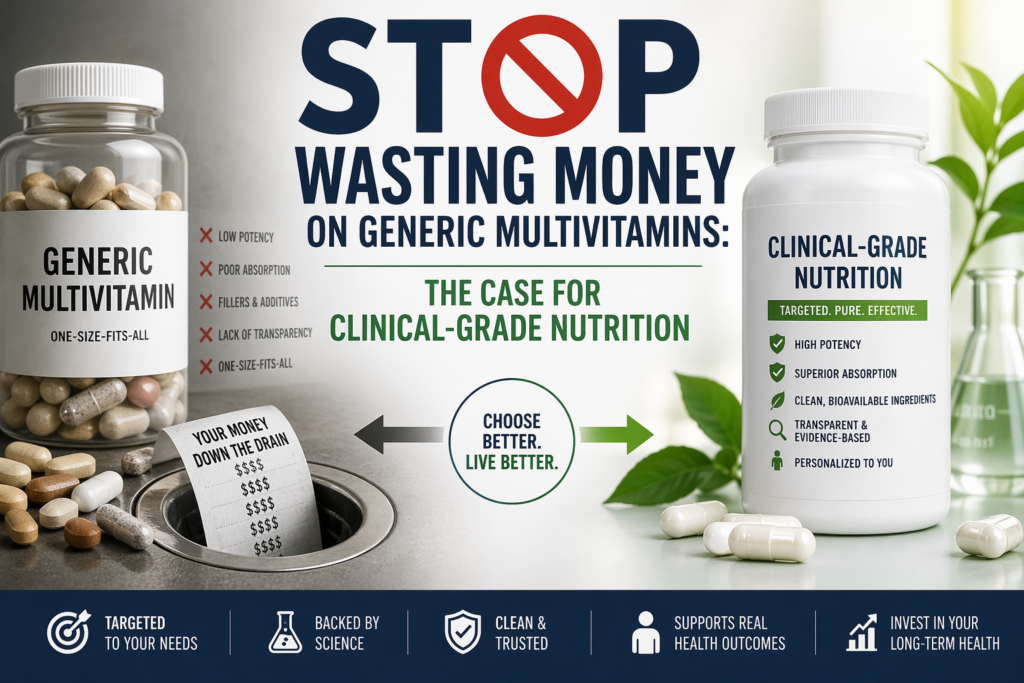
Walk into any pharmacy, health food store, or supermarket in the world, and you’ll find an entire aisle dedicated to multivitamins. Brightly colored bottles promising complete daily nutrition, immune support, energy, and vitality – often at prices that seem almost too reasonable. Millions of people buy them every year, take them faithfully every morning, and assume they’re covered.
They’re probably not.
The uncomfortable truth about most over-the-counter multivitamins is that they are formulated to meet the lowest possible regulatory threshold — not to produce meaningful health outcomes. And for people living with autoimmune conditions, chronic inflammation, or complex nutritional deficiencies, the gap between a generic daily multivitamin and clinical-grade nutrition is not a marketing distinction. It is the difference between real therapeutic support and expensive urine.
Here’s what the science actually says — and what to look for instead.
The Problem With “One-Size-Fits-All” Nutrition
The foundation of the generic multivitamin industry rests on a concept called the Recommended Daily Allowance, or RDA. RDAs were developed in the 1940s by the United States National Academy of Sciences with one specific goal: to prevent acute nutritional deficiency diseases in the general population. They were designed to prevent scurvy, not to optimize mitochondrial function. To prevent rickets, not to support immune regulation in someone with Hashimoto’s thyroiditis.
The RDA, by design, represents the minimum intake sufficient for most healthy people to avoid clinically visible deficiency. It says nothing about the optimal intake required for cellular repair, immune modulation, hormonal balance, or chronic disease prevention — particularly in individuals whose absorption, metabolism, or nutritional demands deviate significantly from the “average healthy adult” baseline.
And most people with autoimmune conditions are anything but average in their nutritional requirements.
Autoimmune disease profoundly alters nutrient metabolism. Chronic systemic inflammation increases the body’s demand for antioxidants, B vitamins, zinc, magnesium, and omega-3 fatty acids. Many autoimmune conditions damage the gut lining, severely impairing the absorption of fat-soluble vitamins like vitamins D, vitamins A, vitamins E, and vitamins K. Medications commonly prescribed for autoimmune conditions — methotrexate, sulfasalazine, and corticosteroids – deplete specific critical nutrients. An RDA-based multivitamin, formulated for a healthy person with normal absorption and no inflammatory burden, simply cannot address these elevated and specific needs.
The Bioavailability Problem: Most of What You Swallow, You Never Absorb
Even if a generic multivitamin contains nominally adequate amounts of essential nutrients, the forms in which those nutrients are delivered often make them largely unavailable to the body.
Take magnesium as an example. It is one of the most important minerals in human biology — involved in over 300 enzymatic reactions, critical for energy production, nerve function, and sleep. Most inexpensive multivitamins use magnesium oxide, which has a bioavailability of around 4%. That means roughly 96% of the dose passes through the digestive tract without being absorbed. Magnesium glycinate or magnesium malate, by contrast, are highly bioavailable forms that are well-tolerated and efficiently utilized by cells.
The same problem applies to:
Vitamin B12: Cyanocobalamin (the cheap form in most multivitamins) must be converted by the body into methylcobalamin before it can be used. In people with MTHFR gene variants — which affect a significant percentage of the population — this conversion is impaired, meaning cyanocobalamin supplementation can be almost completely ineffective. Methylcobalamin, the active form, bypasses this problem entirely.
Folate: Folic acid is the synthetic form found in most supplements. For people with MTHFR variants, it is not just ineffective – it can actually accumulate and compete with active folate at receptor sites, potentially worsening deficiency. Methylfolate (5-MTHF) is the bioavailable form that the body can actually use.
Vitamin D: Most supplements use D2 (ergocalciferol), which is less potent and shorter-acting than D3 (cholecalciferol), the form naturally produced by skin in response to sunlight and the form shown in research to be most effective at raising serum levels. D3 combined with vitamin K2 (MK-7) is the clinically preferred formulation for ensuring vitamin D is properly directed to bones and immune cells rather than soft tissues.
Iron: Ferrous sulfate — the default form in mass-market supplements — is poorly absorbed, frequently causes gastrointestinal distress, and generates oxidative stress in the gut. Ferrous bisglycinate is gentler, better absorbed, and does not produce the same oxidative side effects.
Form matters enormously. A supplement is not just a list of ingredients — it is a delivery mechanism, and if the delivery mechanism fails, the ingredient is irrelevant.
Why Clinical-Grade Nutrition Is Different
Clinical-grade nutrition is built on a fundamentally different set of priorities. Rather than checking boxes against RDA values at the lowest possible cost, clinical formulations are designed around therapeutic outcomes: maximizing bioavailability, addressing specific biochemical pathways, accounting for common genetic variants that affect nutrient metabolism, and meeting the elevated demands of individuals with compromised gut function or chronic disease.
Key characteristics that distinguish clinical-grade from generic nutrition include:
Therapeutic dosing: Clinical formulations provide doses based on what research shows is needed to produce meaningful changes in blood levels, biomarkers, or functional outcomes — not just to technically hit an RDA threshold.
Bioavailable forms: Active, methylated, and chelated forms of nutrients are used throughout, ensuring that what’s on the label is actually what reaches the cells that need it.
Synergistic cofactor combinations: Nutrients don’t work in isolation. Clinical-grade formulas are designed with biochemical synergies in mind — vitamin D with K2, magnesium with B6, zinc with copper in appropriate ratios — to ensure nutrients work together rather than competing or creating secondary deficiencies.
Third-party testing and manufacturing standards: Clinical-grade products are manufactured under pharmaceutical-level quality controls (GMP certified) and verified by independent third-party labs for potency, purity, and the absence of contaminants. This is rarely true of off-the-shelf multivitamins.
Nutrition as Medicine for Autoimmune Conditions
For people managing autoimmune conditions, the stakes of nutritional adequacy are particularly high. The immune system is extraordinarily nutrient-dependent. Vitamin D regulates T-regulatory cell activity – the immune cells responsible for preventing the self-attack that defines autoimmune disease. Zinc is essential for thymic function and the development of immune tolerance. Omega-3 fatty acids (EPA and DHA) directly modulate inflammatory signaling through prostaglandin and cytokine pathways.
Research consistently shows that deficiencies in vitamin D, omega-3s, magnesium, zinc, and B vitamins are disproportionately prevalent in autoimmune populations — and that correcting these deficiencies through well-formulated, bioavailable supplementation can produce measurable improvements in disease activity, fatigue, and quality of life.
This is precisely why generic multivitamins fall short. They are not designed for compromised absorption. They don’t use the forms needed to bypass metabolic bottlenecks. And they don’t deliver the doses required to correct established deficiencies or support the elevated biochemical demands of a chronically inflamed immune system.
At Autoimmunity Care, the philosophy of clinical-grade nutrition is embedded in every product. Their formulations are built around the specific nutritional needs of individuals with autoimmune and inflammatory conditions – using bioavailable forms, therapeutic doses, and evidence-based combinations designed to address the root biochemical deficiencies that drive immune dysregulation.
What to Look for When Choosing Supplements
If you’re ready to move beyond the generic multivitamin, here are the practical benchmarks for evaluating whether a supplement meets clinical-grade standards:
Check the forms: Look for methylcobalamin (not cyanocobalamin), methylfolate (not folic acid), magnesium glycinate or malate (not oxide), vitamin D3 (not D2), and chelated minerals (not inorganic sulfates or carbonates).
Assess the doses: Compare doses against research-backed therapeutic ranges, not just RDA percentages. 100% of the RDA for vitamin D (400 IU) is clinically insufficient for most adults — the functional range most practitioners work with is 2,000–5,000 IU, depending on baseline levels.
Verify third-party testing: Look for NSF, USP, or Informed Sport certification, or brands that publish third-party certificates of analysis for each batch.
Consider the source: Products formulated by practitioners or companies with clinical advisory boards and published sourcing standards are more likely to prioritize efficacy over margin.
The Bottom Line
The supplement industry profits from the gap between perception and reality — the perception that taking a daily multivitamin constitutes meaningful nutritional insurance, and the reality that most products on the market are underdosed, poorly absorbed, and formulated for compliance with minimum standards rather than genuine therapeutic effect.
If you are managing an autoimmune condition, navigating chronic inflammation, or simply trying to support your body at the highest possible level, you deserve nutrition that is formulated with the same rigor as the condition you’re addressing. That means clinical-grade, bioavailable, therapeutically dosed nutrition — not the cheapest option at eye level in the pharmacy aisle.
Your investment in your health should actually work.